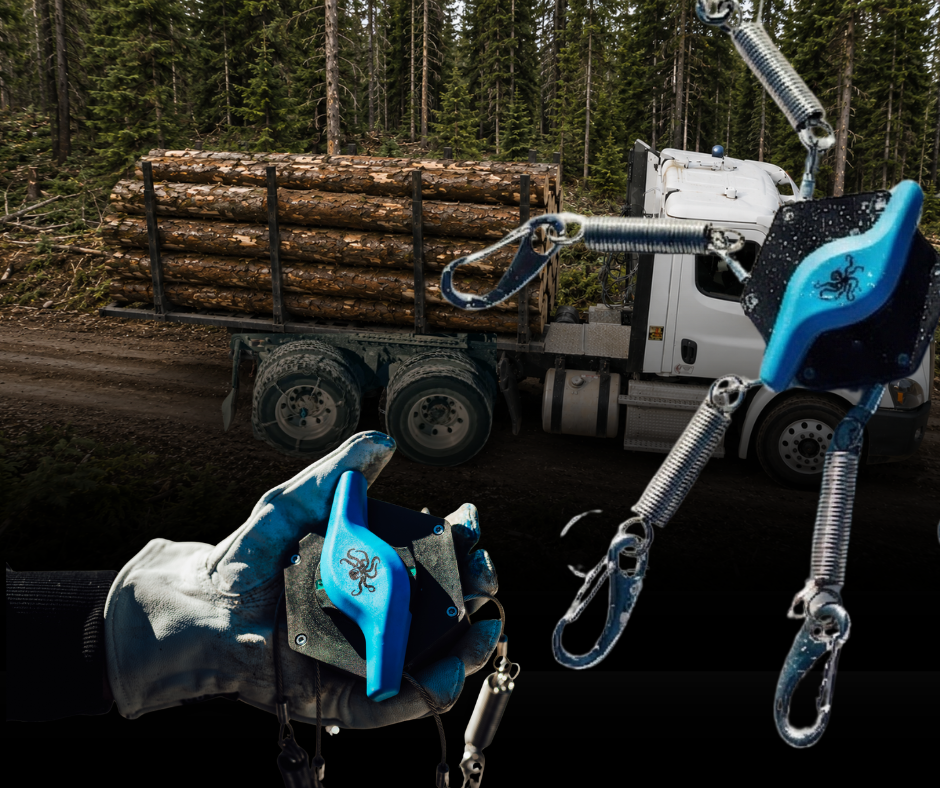
Highway chain laws get all the attention, but if you're running a log truck or working forestry roads for a living, your real chain problems start where the pavement ends. There's no plow service on a logging spur. There's no shoulder to safely pull onto when a chain comes loose three miles up a grade. And there's often no signal to call for help if something goes wrong. For independent operators, chains aren't a seasonal inconvenience — they're a daily piece of safety equipment.
Why Logging Roads Are a Different Problem
Forestry and logging routes don't behave like state highways, and that changes what you need from your chains and tensioning system.
- Grades are steeper and longer. Sustained climbs and descents put continuous strain on chain tension that a quick highway pass doesn't.
- Surfaces are inconsistent. Loose gravel, ruts, mud under snow, and unmaintained shoulders all add stress points that can shake a chain loose faster than a plowed road would.
- You're often alone. A breakdown or loose chain on a remote spur road can mean hours before help arrives, if cell coverage even reaches you.
- Loads are heavier. A loaded log truck puts significantly more stress on tires, chains, and mounting hardware than an empty haul or passenger vehicle.
- Weather changes fast at elevation. Logging operations frequently work at higher elevations where conditions can shift from manageable to severe within a single shift.
What Independent Operators Need to Know About Chain Laws
Most state chain laws are written with highway driving in mind, but the underlying compliance principle still applies on logging roads and any state or forest service land you cross to reach a job site.
- Check both state DOT rules and land-management requirements. Forest Service roads, state trust lands, and private timber roads may carry their own seasonal chain requirements in addition to state law.
- Drive axle and trailer requirements vary. Some states require chains on drive axles only; others require additional trailer tire chains for heavier vehicles once restrictions are in effect.
- Weight class matters. Heavier commercial vehicles are frequently held to stricter chain requirements than passenger vehicles, even within the same state.
- When in doubt, chain up before the grade, not on it. Stopping to chain up mid-climb on a narrow logging road is far more dangerous than doing it at the base, on solid ground.
Common Chain Failures on Logging Routes
- Loosening from sustained vibration. Long, rough grades shake hardware loose faster than smooth highway miles.
- Bungee and strap failures. Rubber tie-downs lose tension in cold temperatures and are even more prone to snapping under the constant jolting of an unmaintained road.
- Chain wrap and tire damage. A chain that's gone slack can wrap around the axle or suspension components before a driver even notices, turning a simple fix into an expensive repair.
- Delayed detection. On a quiet highway you might hear a chain start to slap. On a loud diesel grinding up a logging grade, you often don't notice until the damage is already done.
How an Automatic Tensioner Helps on Backcountry Routes
This is exactly the environment automatic tensioning was built for. A system like the Kranken or Kranken XL holds constant, even tension on the chain mechanically, instead of relying on a bungee cord or strap that loses grip as it gets cold and gets shaken loose by rough terrain.
- Set it once at the base of the grade and don't think about it again until you're back on maintained road.
- No roadside stops on unstable shoulders to re-tighten a loosening cord.
- Built for heavier-duty use, including commercial trucks and fleet vehicles, not just passenger cars.
- Reduces the chance of a chain failure turning into a stranded vehicle miles from help.
Frequently Asked Questions
Do logging trucks need different snow chains than highway trucks?
Logging trucks generally need heavier-duty chains rated for their axle weight and tire size, and benefit from tensioning systems built to withstand the constant vibration and rough surfaces of unmaintained roads — conditions far more demanding than typical highway driving.
Are forest service roads subject to the same chain laws as state highways?
Not always. Forest Service roads, state trust lands, and private timber roads can carry their own seasonal traction device requirements in addition to standard state DOT chain laws, so independent operators should check both before heading out.
Why do chains fail more often on logging roads than highways?
Logging roads combine longer grades, rougher and looser surfaces, and heavier loads, all of which place more continuous stress on chain tension than typical plowed highway driving — which is also why temporary fixes like bungee cords fail faster in this environment.
Can an automatic chain tensioner handle a fully loaded log truck?
A tensioner built for commercial-grade use, like the Kranken XL, is designed to maintain consistent tension under the higher loads and tire sizes common to log trucks and other heavy forestry equipment.